LLM Research
As I approach the completion of my Master’s in Computational Linguistics (AI Track) at Heidelberg University, I’m looking for full-time opportunities in AI research or AI software development where I can work on agentic, multimodal, and practical AI systems.
My work combines research experimentation with system-level engineering, with hands-on experience in tool-using agents, LLM/VLM evaluation, RAG, MCP, multimodal grounding, LoRA, quantization, and knowledge distillation.
I’m particularly interested in how AI systems behave once models can observe, remember, call tools, and interact with external environments — and how those systems can be evaluated, made more efficient, and made more reliable.
Below are several recent projects reflecting this approach.
Hybrid Conv+GQA vs. Dense Transformers
📅 Aug 2026 · GitHub · Report PDF
Keywords: LLM Systems · Efficient Inference · Long Context · LoRA
Compared LFM2.5-1.2B’s hybrid Conv+GQA architecture with the Qwen3-1.7B dense Transformer across inference efficiency, long-context behavior, and LoRA adaptation.
Built benchmarks for throughput, TTFT, GPU memory, KV-cache usage, retrieval, and perplexity.
Observed up to 11.5× higher throughput, ~45% lower inference memory, and a 9.3× smaller KV cache for the hybrid model, while dense attention remained stronger on precise long-range retrieval and post-fine-tuning quality.
Action-Conditioned World Models
📅 Aug 2026 · GitHub · Report PDF
Keywords: World Models · Representation Learning · DINOv2 · Model Predictive Control
Extended DINO-WM on PointMaze to study how visual representation choice and transition uncertainty affect latent prediction and planning.
Compared DINOv2, V-JEPA 2, and VFM-VAE, and conducted a controlled Patch/CLS × Deterministic/Gaussian ablation.
Deterministic patch features remained the most reliable baseline, while CLS representations were surprisingly competitive and Gaussian dynamics did not consistently improve planning performance.
Smart Deal Finder — Multimodal Shopping Agent
📅 2026 · GitHub
Keywords: Multimodal AI · Document AI · VLM · LLM Agents · Tool Use
Built a multimodal Document AI pipeline for extracting structured product, price, discount, and related information from retail documents.
Integrated the extracted data with a tool-using shopping agent that converts user requirements into actionable shopping plans.
The project connects multimodal understanding, structured extraction, LLM reasoning, and external tools in an end-to-end AI workflow.
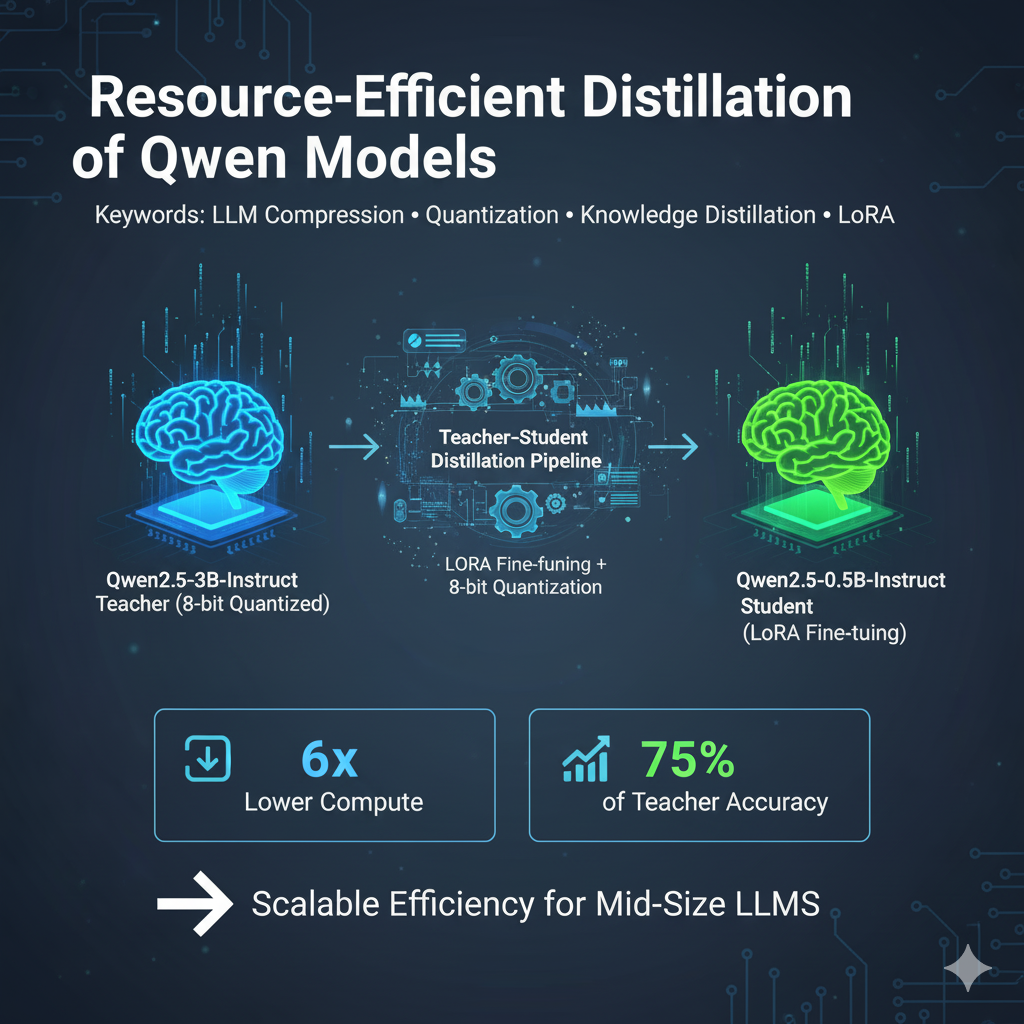
Resource-Efficient Distillation of Qwen Models
📅 Jul – Sep 2025 · GitHub · Report PDF
Keywords: LLM Compression · Quantization · Knowledge Distillation · LoRA
Reproduced and extended a teacher–student distillation pipeline for Qwen2.5–0.5B-Instruct.
Combined LoRA fine-tuning with 8-bit quantization to compress the model from 3B to 0.5B parameters.
Achieved 75% of teacher accuracy with 6× lower compute — demonstrating scalable efficiency for mid-size LLMs.
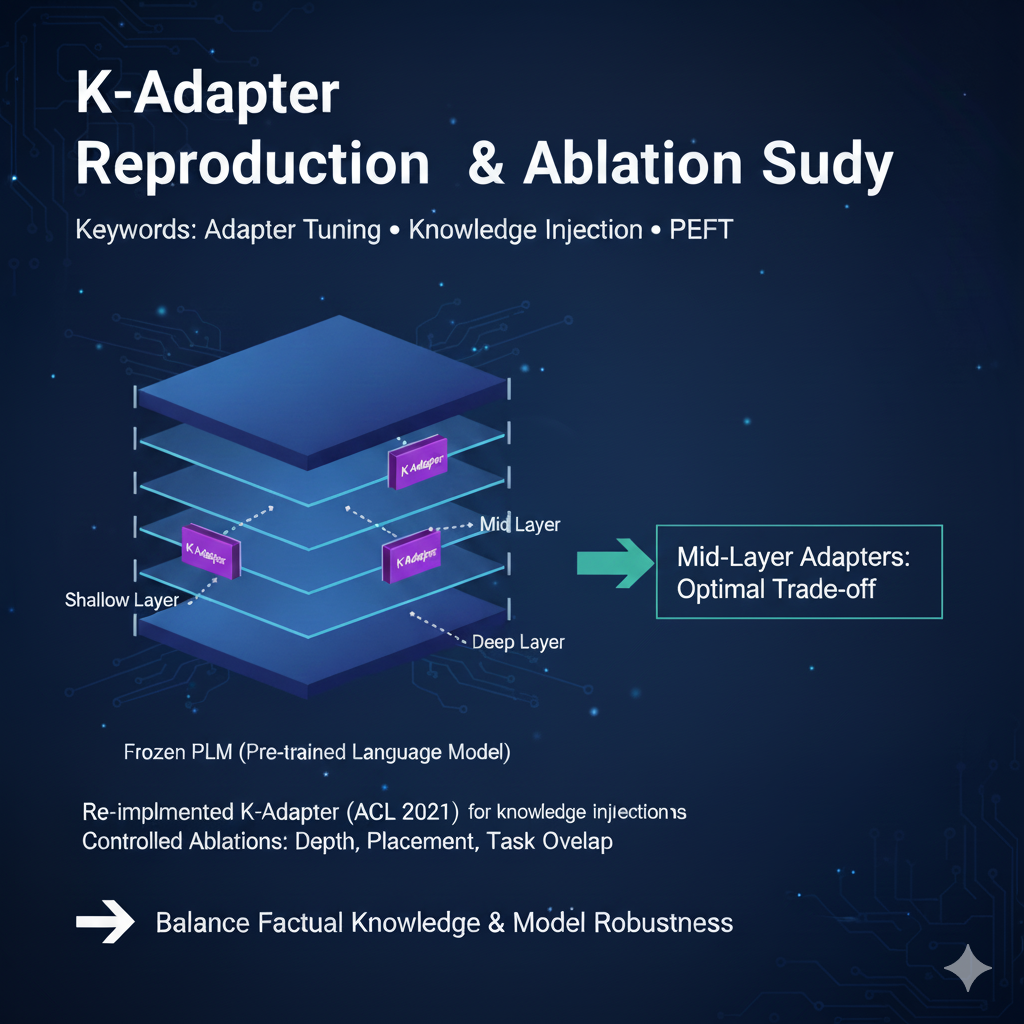
K-Adapter Reproduction & Ablation Study
📅 Jul – Sep 2025 · GitHub · Report PDF
Keywords: Adapter Tuning · Knowledge Injection · PEFT
Re-implemented K-Adapter (ACL 2021) for knowledge injection via frozen PLMs.
Ran controlled ablations on adapter layer depth, placement, and task overlap.
Found mid-layer adapters offered optimal trade-offs between factual recall and model stability.
Hierarchical Character-Level Language Model
📅 Jul – Sep 2025 · GitHub · Report PDF
Keywords: Hierarchical LM · Cache Mechanisms · Representation Learning
Re-implemented HCLM+Cache (Kawakami et al., 2017) in PyTorch to study word reuse in open-vocabulary settings.
Introduced vectorized computation and continuous cache management, improving throughput 3.8× and reducing validation BPC by 11.8%.
Showed that the cache component contributes most to long-range linguistic coherence.
LoRA-Driven Anime Style Generation
📅 Jul – Sep 2025 · GitHub · Report PDF
Keywords: LoRA · Diffusion Models · Multimodal Adaptation
Benchmarked LoRA against Textual Inversion and DreamBooth for anime-style generation using Stable Diffusion v1.5.
Showed that LoRA achieved ~47 FID reduction under small (100-image) datasets while using <2% trainable parameters.
Explored style blending by interpolating LoRA checkpoints, demonstrating compositional flexibility.
Plant Recognition with CNNs and Transfer Learning
📅 Jul 2025 · Report PDF
Keywords: Computer Vision · CNN · Transfer Learning
Developed and compared ResNet, EfficientNet, and Vision Transformer baselines on a plant classification dataset.
Demonstrated how transfer learning significantly improves data efficiency —
serving as an early exploration into model generalization and feature reuse.
Self-Conditioned Generation (Reimplementation)
📅 Jan – Mar 2025 · GitHub · Report PDF
Keywords: Mechanistic Interpretability · Hidden-State Control
Reproduced Self-Conditioned Pretrained LMs (ICML 2022) focusing on internal feedback loops in generation.
Analyzed how hidden-state reuse improves fluency and stability over standard autoregressive decoding.
Demonstrated controllable text steering without external conditioning or retraining.
Data Contamination in Large Models
📅 Feb 2025 · Report PDF
Keywords: LLM Evaluation · Dataset Integrity · Temporal Robustness
Investigated contamination within open LLM evaluation datasets.
Implemented prefix-based detection and cross-version comparison pipelines to quantify leakage effects.
Provided empirical support for stricter dataset curation in benchmark design.
MLLM: Towards Multimodal Language Models
📅 Mar 2025 · Report PDF
Keywords: Multimodal LLMs · Vision–Language Alignment
Surveyed and analyzed recent multimodal LLM architectures (e.g., BLIP-2, Flamingo, LLaVA).
Focused on how frozen-language backbones interact with visual Q-formers and alignment objectives.
Discussed open challenges in cross-modal grounding and scalability of visual–text fusion.
Temporal Reasoning in Clinical NLP
📅 Mar 2025 · Report PDF
Keywords: Temporal Reasoning · Clinical NLP · Knowledge Graphs
Reviewed how LLMs handle temporal information in clinical narratives.
Summarized key challenges in chronological inference and discussed methods like
TIMER-Instruct and temporal knowledge graphs
for improving event sequencing and model reliability.
✨ Research Focus
Across these projects, I’m interested in a common question:
How can we build AI systems that are not only capable, but also efficient, grounded, interpretable, and reliable when interacting with real environments?
I approach this from several directions:
efficient LLM architectures and adaptation, multimodal representation learning,
world models, and tool-using agents.
What interests me most is the boundary between model research and system behavior —
how architectural choices affect deployment,
how representations affect downstream decisions,
and how models can turn multimodal information into reliable actions.